How to Repot a Houseplant (Without Killing It)
Your plant has outgrown its home. Here is how to upgrade it safely.
Repotting a houseplant is one of the best things you can do for it - and it is not as scary as it sounds. If your plant's roots are circling the bottom of the pot or poking through the drainage holes, it is telling you it needs more space. The good news is that repotting is straightforward, and most plants bounce back quickly when you do it right.
Here is everything you need to know, step by step.
Signs your plant needs repotting
Not sure if it is time? Look for these clues:
- Roots growing out of the drainage holes. This is the clearest sign. Your plant has literally outgrown its home.
- Water runs straight through the pot without soaking into the soil. This means the root ball is so dense there is no soil left to absorb moisture.
- The plant dries out much faster than usual. If you are watering every few days and it is still thirsty, the roots have taken over.
- Growth has stalled even though light and watering are fine. There is simply no room left to grow.
- The plant is top-heavy and tips over. The pot is too small to support the plant above it.
- It has been 2+ years since the last repot. Even if none of the above apply, fresh soil alone can give your plant a boost.
When to repot
Spring is ideal. Your plant is waking up from its winter rest and entering its active growing season. This gives it the best chance to recover and settle into its new home.
You can also repot in early summer. Avoid repotting in late autumn or winter unless it is an emergency (like root rot) - your plant is resting and will struggle to recover.
Never repot a stressed plant unless the stress is caused by the pot itself. If your plant is dealing with pests, sunburn, or dehydration, fix those issues first.
How to choose the right pot size
This is where many people go wrong. Bigger is not always better.
Go up by only 2-5cm (1-2 inches) in diameter. That is it. A pot that is too large holds too much moisture around the roots, which leads to root rot.
For a plant in a 12cm pot, move to a 14-16cm pot. For a plant in a 20cm pot, a 22-24cm pot is perfect.
Always choose a pot with drainage holes. No drainage = standing water = root rot. If you love a decorative pot without holes, use it as a cover pot and keep the plant in a plastic nursery pot inside it.
Which soil to use
Different plants need different soil mixes, but here is a solid starting point:
- Most tropical houseplants (pothos, monstera, philodendron): A standard indoor potting mix with added perlite for drainage. Aim for about 70% potting mix and 30% perlite.
- Succulents and cacti: A gritty, fast-draining mix. Equal parts potting soil, perlite, and coarse sand.
- Ferns and calatheas: A moisture-retaining mix. Standard potting mix with a handful of coco coir or peat moss mixed in.
- Orchids: They need their own special bark-based mix - never regular soil.
Never use garden soil for indoor plants. It is too dense, may contain pests, and does not drain well enough in a pot.
Step-by-step repotting guide
You will need: New pot, fresh soil, a trowel or spoon, newspaper or a tray (for mess), and optionally some clean scissors.
Step 1: Water the plant the day before. A well-hydrated plant handles the stress of repotting much better than a dry one. Moist soil also slides out of the old pot more easily.
Step 2: Prepare the new pot. Add a layer of fresh soil to the bottom of the new pot - enough so the plant will sit at the same depth it was before.
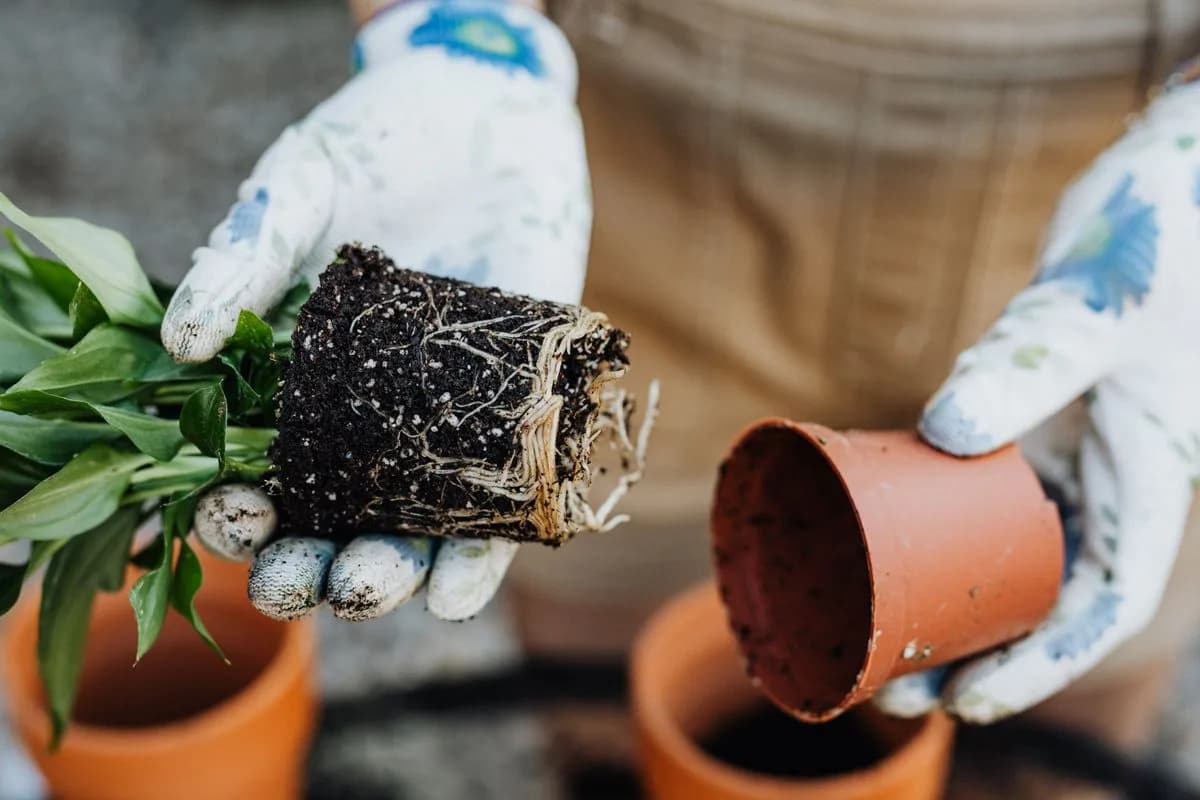
Step 3: Remove the plant from its old pot. Turn the pot on its side and gently squeeze the sides to loosen the root ball. Slide the plant out. If it is stuck, run a butter knife around the inside edge of the pot.
Step 4: Check the roots. This is your chance to inspect. Healthy roots are white, tan, or light brown. If you see dark brown, mushy roots, trim them away with clean scissors - that is root rot.
Step 5: Loosen the root ball. Gently tease apart the outer roots with your fingers. If the roots are tightly circling (root-bound), loosen them so they can grow outward into the new soil. You will not hurt the plant doing this.
Step 6: Place in the new pot. Set the plant in the centre and fill around it with fresh soil. Press gently to remove air pockets, but do not pack it down hard - roots need air.
Step 7: Water thoroughly. Water until it drains out the bottom. This settles the soil around the roots and gives your plant a good drink after the move.
Step 8: Skip fertilizing for 2-4 weeks. Fresh soil has nutrients in it already, and your plant needs time to recover before being fed.
After repotting - what to expect
Your plant might look a little droopy for a few days. This is normal. It is adjusting to its new space. Keep it in its usual spot (do not move it somewhere different AND repot it - that is two stresses at once).
Avoid direct sunlight for a few days after repotting. Resume your normal care routine after about a week.
Do not panic about a yellow leaf or two. Some plants drop an older leaf after repotting as they redirect energy to establishing new roots. As long as new growth looks healthy, you are fine.
Common repotting mistakes to avoid
- Choosing a pot that is way too big. Stick to 2-5cm larger. Excess soil holds excess water.
- Repotting when the plant is already stressed. Fix the existing problem first.
- Burying the stem deeper than it was before. Keep the soil level the same. Buried stems can rot.
- Forgetting drainage holes. No exceptions.
- Repotting in winter. Unless it is urgent, wait until spring.
A note on root-bound plants
Some plants actually like being a little snug in their pots. Snake plants, spider plants, and peace lilies often bloom more when slightly root-bound. If your plant looks healthy and is growing fine, there is no rush to repot just because you see a root or two.
Repotting does not have to be stressful - for you or your plant. With LeafLovers, you can track when you last repotted each plant so you always know when it is time for a refresh.
Related guides
Free weekly plant care tips
Get personalised tips delivered to your inbox. No app needed, no spam, unsubscribe anytime.
No credit card. No tricks. No strings. Just plants.