String of Pearls Care: Why Everyone Kills These (and How Not To)
Everyone kills these. The secret? Stop overwatering them.
The number one reason string of pearls die is overwatering. These succulents store water in their pearl-shaped leaves and need far less water than you think - about every 10-14 days in summer and every 3-4 weeks in winter. Water only when the soil is completely dry and the pearls start to look slightly less round.
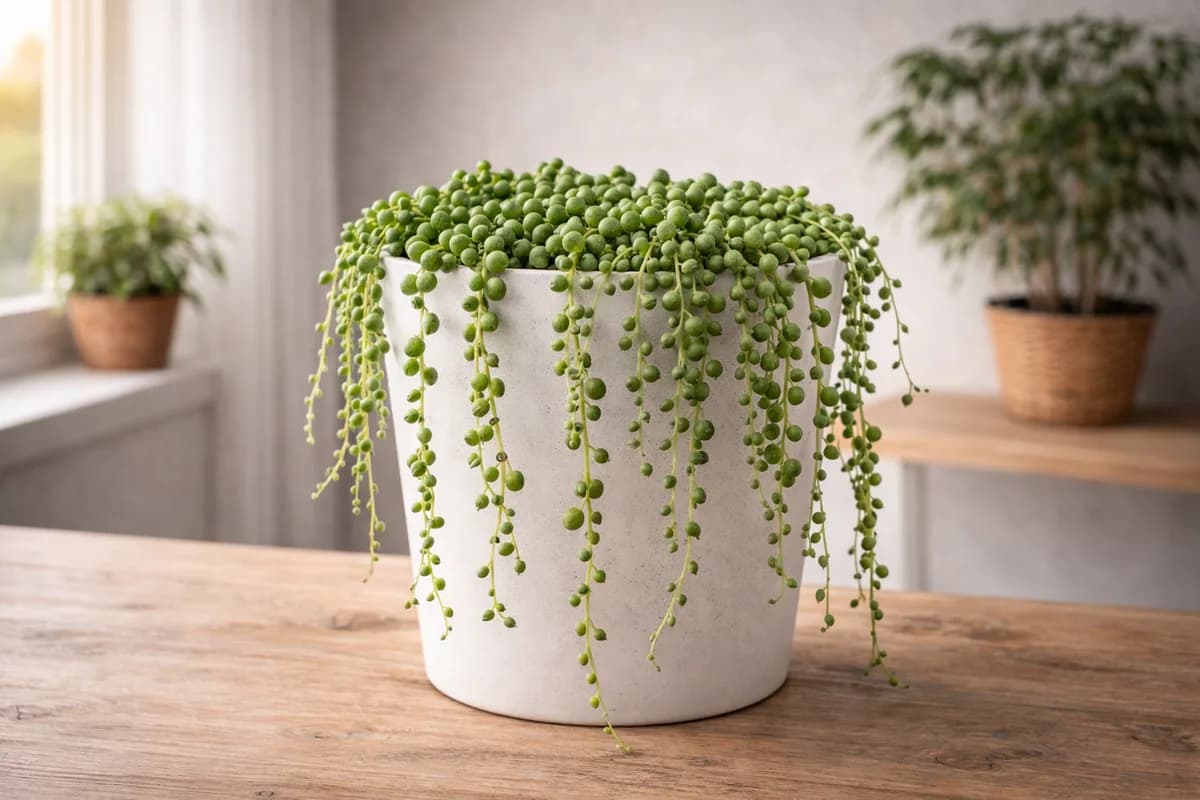
String of pearls (Senecio rowleyanus) has a reputation as a plant killer. Social media is full of people mourning their dead strings. But the plant isn't actually difficult - it just has different needs than most houseplants. Once you understand it's a succulent (not a tropical plant), everything clicks.
The number one mistake: overwatering
Let us get this out of the way first because this is why 90% of string of pearls die.
Why people overwater them:
- The trailing tendrils look delicate, so people assume they need frequent watering
- The soil surface can look dry while the center is still moist
- People treat them like tropical trailing plants (pothos, philodendrons)
How to tell you're overwatering:
- Pearls are mushy, translucent, or bursting
- Stems are turning brown and mushy
- There is a rotting smell
- Pearls are falling off with the slightest touch
The fix: If you catch it early, stop watering immediately and let the soil dry completely. Move to a warm, bright spot to speed drying. If stems are already mushy, cut above the rot and propagate the healthy sections.
The correct watering technique
When to water
- The soil must be completely dry - not just the surface, all the way through
- The pearls will give you a visual cue: they look slightly less plump and round when thirsty
- Some pearl varieties develop slight wrinkles or lines when they need water
How to water
- Water the soil directly, not over the plant (wet pearls sitting on wet soil = rot)
- Water thoroughly until it drains from the bottom
- Empty the saucer immediately
- Let the soil dry completely before the next watering
- Bottom watering works well: place the pot in a tray of water for 10 minutes, then remove
Schedule guide
| Season | Frequency | Notes |
|---|---|---|
| Summer | Every 10-14 days | Active growth, warmer, dries faster |
| Autumn | Every 14-21 days | Slowing down |
| Winter | Every 21-30 days | Near-dormant, very little water needed |
| Spring | Every 10-14 days | Growth resumes |
Light
String of pearls need more light than most people give them.
Ideal
- Bright indirect light with 2-3 hours of direct morning sun
- East-facing windows are perfect
- South or west-facing windows with a sheer curtain work well
Not enough light (common problem)
- Strings become leggy with wide gaps between pearls
- Growth slows or stops
- The plant looks sparse and thin
Too much light
- Pearls become shriveled and brown
- Sunburn marks (bleached spots)
- This is less common than too little light
Soil and drainage
This is critical. String of pearls need soil that dries out fast.
Best soil mix:
- Cactus and succulent mix (off the shelf works)
- Or: regular potting soil mixed 50/50 with perlite, pumice, or coarse sand
- The goal: excellent drainage, dries quickly, doesn't hold moisture
Pot requirements:
- Drainage holes are absolutely essential - no exceptions
- Terracotta pots are ideal (they wick moisture away)
- Shallow pots work better than deep ones (the roots are shallow)
- Unglazed clay > plastic for moisture management
Propagation
The good news about string of pearls: they propagate easily. If part of your plant is dying, you can almost always save healthy sections.
How to propagate
- Cut healthy sections of stem (at least 8-10cm / 3-4 inches long)
- Remove the pearls from the bottom 2-3cm of the cutting
- Let the cut end dry for 24 hours (this prevents rot)
- Lay the cutting on top of moist (not wet) succulent soil
- You can also pin sections of stem against the soil surface with bobby pins
- Mist very lightly every few days - just enough to keep the top of the soil barely moist
- Roots develop in 2-4 weeks
- Once rooted, transition to normal (infrequent) watering
Water propagation
- Place cuttings in water with the nodes submerged
- Change water every few days
- Roots appear in 2-3 weeks
- Transition to soil once roots are 3-5cm long
- Note: water-rooted plants need a gradual transition to soil
Temperature and humidity
- Temperature: 18-27C (65-80F) during the day, can handle 10C (50F) at night
- Humidity: Normal to low household humidity (30-40%) is fine. They do NOT like high humidity
- Avoid: Cold drafts, frost, and damp environments
- Good air circulation helps prevent rot
Feeding
- Feed every 4-6 weeks in spring and summer only
- Use a balanced liquid fertilizer diluted to quarter strength (yes, quarter - not half)
- Do not feed in autumn or winter
- Overfeeding is worse than not feeding at all
Common problems
| Problem | Cause | Fix |
|---|---|---|
| Mushy, translucent pearls | Overwatering | Stop watering, improve drainage |
| Flat, wrinkled pearls | Underwatering | Water thoroughly |
| Sparse, leggy strings | Not enough light | Move to brighter spot |
| Pearls falling off easily | Root rot or overwatering | Check roots, reduce watering |
| Brown, crispy pearls | Sunburn or severe underwatering | Reduce direct sun or water |
| No new growth | Not enough light or nutrients | More light, feed in growing season |
Quick reference
| Light | Bright indirect + 2-3 hours direct morning sun |
|---|---|
| Water | Every 10-14 days (summer), 3-4 weeks (winter), soil must dry completely |
| Humidity | Low to normal (30-40%) - not humidity lovers |
| Difficulty | Intermediate |
| Personality | Mysterious |
| Toxic to pets? | Yes - mildly toxic (cats and dogs) |
Your string of pearls is a Mysterious plant. In LeafLovers, it would say: "I am not as delicate as I look. I am a succulent in disguise. Treat me like one and I will cascade beautifully. Drown me and I will vanish without a trace."
Related guides
Spotted something that needs correcting? Send a message.
Care reference
Need the full care profile for String of Pearls?
Check the encyclopedia for light, watering, soil, pet safety, and pot guidance - then use LeafLovers to fit it to your plant and home.