Calathea Care: Watering, Humidity and Healthy Leaves
A steady routine for patterned leaves, plus help finding the guide for your particular plant.
Quick questions
Are Calathea and Goeppertia the same?
Many popular houseplants formerly called Calathea have been reclassified as Goeppertia. Shops still use the older name. Keep the full botanical name to find species-specific advice.
How often should I water a Calathea?
Check the mix rather than using a fixed interval. Keep it lightly moist during growth, with good drainage, and allow slightly more surface drying when growth slows.
Does misting prevent crispy edges?
Misting does not maintain higher room humidity. Check moisture, roots, light and pests as well as dry air before deciding what to change.
Can Calathea grow in a dark room?
It needs useful daylight or a suitable grow light. Shade from strong sun is different from a dark room, where growth and water use slow down.
Can I propagate a single leaf?
A detached Goeppertia leaf is not the normal way to produce another plant. Divide a healthy established clump with roots attached. Maranta has different propagation options.
Are Calatheas safe for cats and dogs?
ASPCA lists Calathea spp. as non-toxic to cats and dogs. Confirm your plant’s identity rather than extending that listing to every “prayer plant”. Prevent chewing; plant material can still cause stomach upset.
Calathea care becomes easier when you aim for steady moisture, filtered light and humid air, then adjust to the plant in front of you. A brown edge is a reason to check its conditions, not proof that you have failed or that it needs more water.
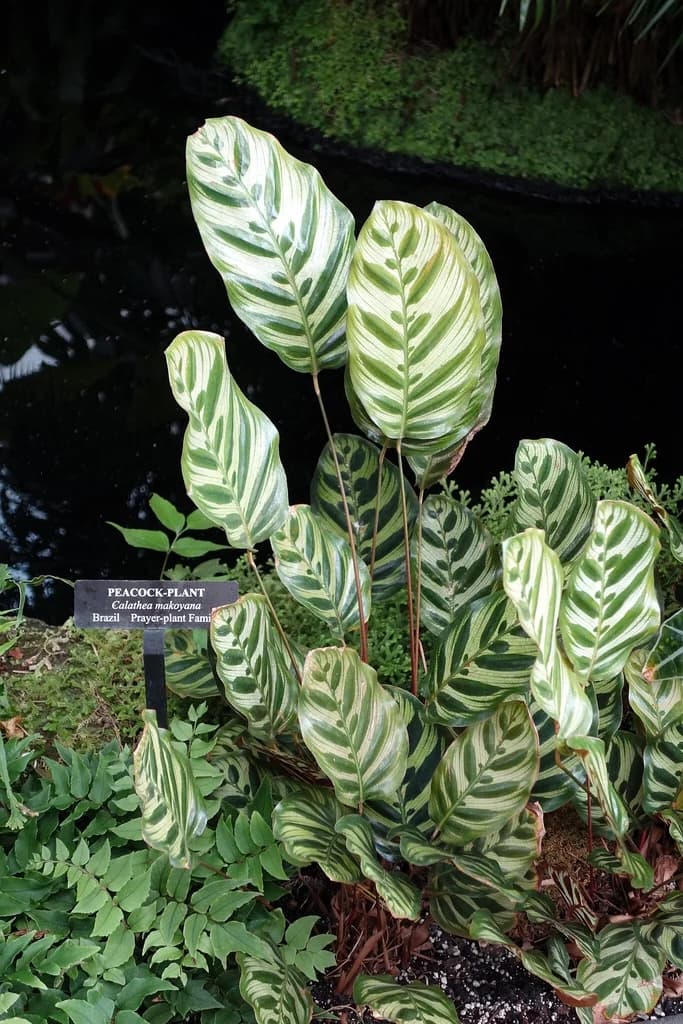
Many familiar houseplants sold as Calathea now belong to Goeppertia. The photograph shows Goeppertia makoyana, the peacock plant. Maranta and Ctenanthe are relatives, but they are separate genera with some different habits.
Find your plant's guide
Use this page for the shared routine. For details that depend on the plant, start here:
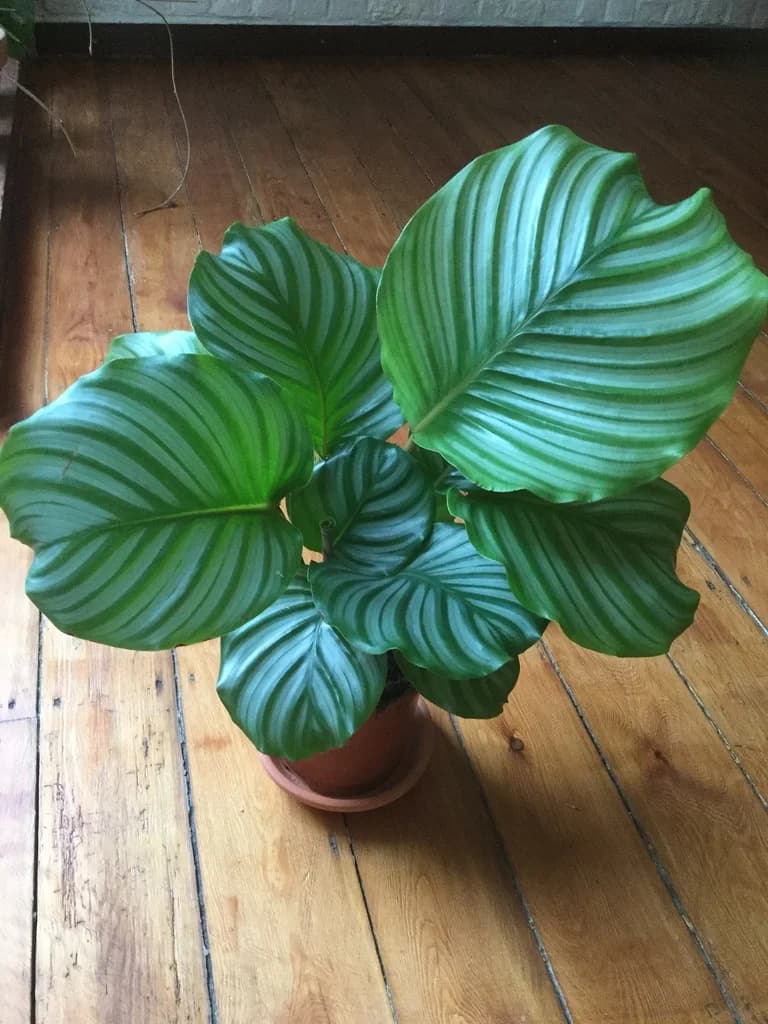
- Calathea orbifolia: large, rounded leaves with silver-green stripes.
- Maranta: spreading stems, often with coloured veins or paired dark markings.
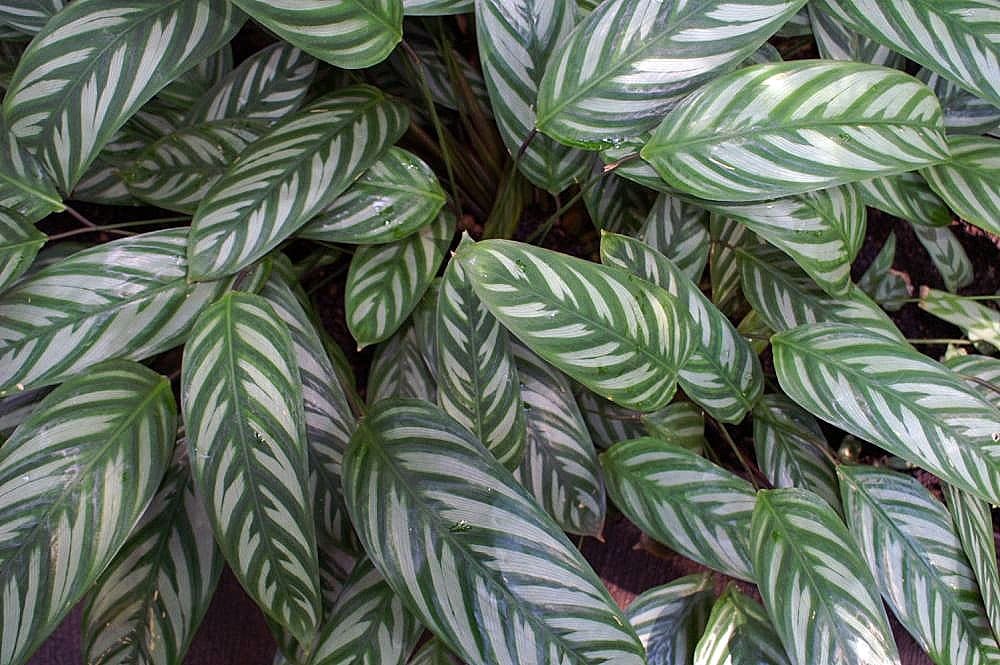
- Fishbone Prayer Plant: Ctenanthe burle-marxii, with dark bands on pale leaves.
- Ctenanthe: the wider Never Never Plant group and its common care problems.
A shop label saying only “prayer plant” is not enough to confirm the species, propagation method or pet-safety advice.
Choose light and a steady temperature
Place the plant where it receives plenty of daylight without prolonged, strong direct sun. A sheer curtain can soften a sunny window; a dim corner is not a substitute for filtered light. Judge the light reaching the leaves rather than choosing a window direction alone.
Keep it away from radiators, air-conditioning outlets and cold window glass. A comfortably warm room with few sudden temperature changes is a better starting point than repeatedly moving the pot to find a perfect spot.
Water after checking the pot
Feel the surface and just below it, and learn how the pot feels as it becomes lighter. During active growth, aim for lightly moist mix without letting the root ball become completely dry. When growth slows, let the surface dry a little more and check before watering again.
Water thoroughly, allow drainage, then empty the saucer or decorative outer pot. A calendar reminder should prompt that check, not an automatic drink. If the mix remains wet and the plant droops, adding water can make matters worse.
Where hard water or mineral buildup seems to be contributing to leaf damage, try rainwater or distilled water. “Filtered” is not a guarantee of low-mineral water: check what your particular filter removes. Do not change the water, fertiliser and location all at once if you want to learn what helps.
Make humidity practical
Measure the room with a hygrometer if dry air is a recurring concern. A suitable humidifier can help; misting briefly wets leaves but does not maintain higher humidity. Avoid turning the room damp or leaving foliage constantly wet.
Look at new leaves over time. Existing crispy tissue will not turn green again, so an old brown edge cannot tell you whether an adjustment is working.
Keep roots comfortable
Use a moisture-retentive, free-draining houseplant mix and a pot with drainage holes. When roots genuinely crowd the container, move up one size rather than putting a small plant in a large volume of wet compost.
Feed modestly while the plant is actively growing, following the product's indoor-plant directions. Extra fertiliser does not repair damaged leaves. For suitable clumping Goeppertia, division at repotting is the usual home propagation method; a detached leaf is not a new plant.
Check before treating damaged leaves
For persistent curling, yellowing or brown edges, check soil moisture and drainage first, then recent sun or temperature changes. Inspect leaf undersides for pests and consider dry air or fertiliser buildup. Several stresses can look alike.
Remove fully dead foliage with clean scissors, but keep healthy leaf area. Record one change and watch the next growth before adding another remedy.
Sources for this guide
8 sources
Spotted something that needs correcting? Send a message.