Calathea Orbifolia Care: Watering, Light and Brown Edges
Help those broad, striped leaves grow well with steady conditions and a few useful checks.
Quick questions
Is orbifolia a Calathea or Goeppertia?
Its accepted botanical name is Goeppertia orbifolia. Calathea orbifolia is the familiar older name still widely used in shops.
How often should I water orbifolia?
Water when the upper mix begins to lose moisture, before the entire root ball dries out. Light, temperature, pot size and drainage all affect the interval.
Does it need 60% humidity?
NC State recommends at least 60% humidity for this species. Measure your room and improve dry conditions where practical, without creating damp walls or constantly wet foliage.
Will brown leaf edges become green again?
No. Damaged tissue stays brown. Look for healthier new growth after correcting the likely cause, and avoid repeatedly changing care because an old mark remains.
Can I grow orbifolia from a leaf cutting?
Use division of an established plant, with roots and growing shoots in each section. A detached leaf alone is not a reliable propagation method.
Is orbifolia safe for pets?
NC State lists Goeppertia orbifolia as non-toxic to cats and dogs. It is still best to prevent chewing, since plant material can upset a pet’s stomach.
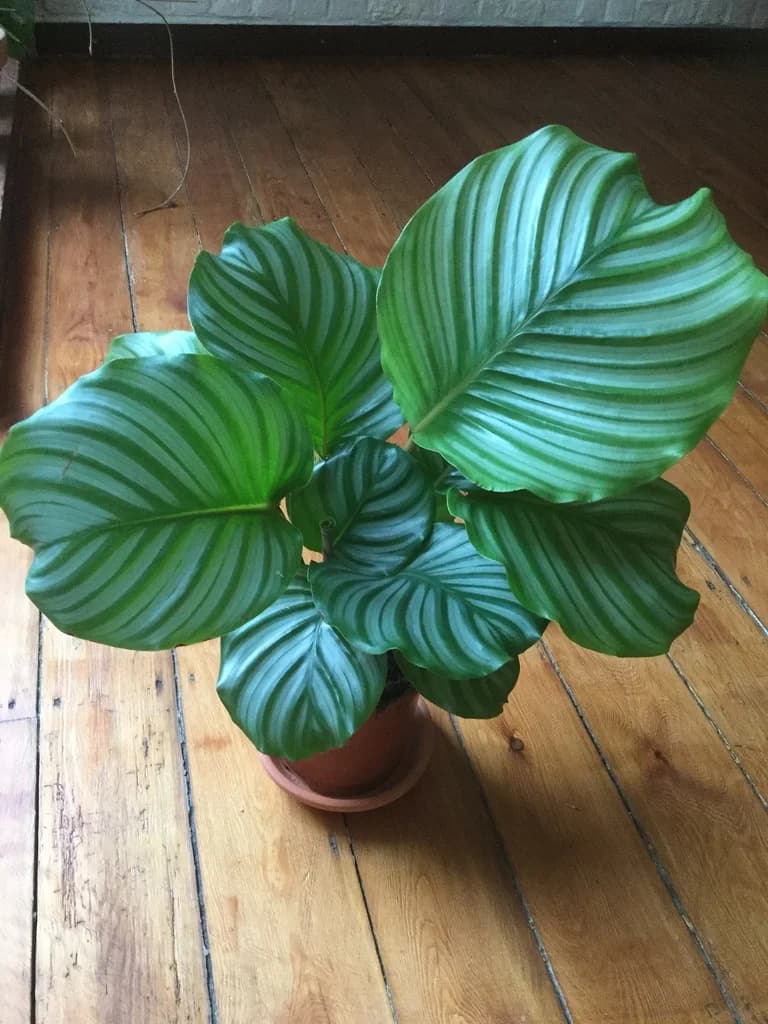
Calathea orbifolia is grown for its broad, rounded leaves and soft silver-green stripes. Its accepted botanical name is Goeppertia orbifolia, although the familiar Calathea name still appears on shop labels.
Start with a bright, sheltered position and roots that stay lightly moist. The aim is steady growth, not flawless old leaves: a small brown edge can remain long after the original problem has passed.
Give the leaves bright, filtered light
Choose a spot with good daylight and protection from strong direct sun. Leave enough room for the wide leaves without pressing them against a hot or cold window. If sunlight falls strongly across the foliage, soften it with a curtain or move the pot back.
Fading is not a diagnosis by itself. Consider both insufficient light and harsh exposure, along with the age and condition of the leaf, before moving the plant.
Check moisture before watering
Feel the surface and beneath it rather than watering every set number of days. Water as the upper mix begins to lose moisture, while the root ball still retains some. Do not wait for the whole pot to become dry or for every leaf to droop.
Water evenly until excess drains away, then empty the outer pot. In cooler or darker conditions, the same pot usually needs longer between drinks. If it still feels wet, wait and investigate drainage rather than following a reminder blindly.
Rainwater or distilled water can be useful where tap-water minerals contribute to browning. Check a filter's specifications before assuming “filtered” water has removed the substances you are trying to avoid.
Provide humidity without keeping leaves wet
Orbifolia prefers humid air and stable warmth. NC State suggests humidity of at least 60%; treat this as a growing preference, not a reason to make a room persistently damp. Measure conditions first and use a humidifier appropriately if needed.
Keep the plant out of heating draughts and avoid repeated temperature swings. Misting is not a lasting substitute for room humidity. Gently wipe dust from the broad leaves with a soft damp cloth, supporting each leaf as you work.
Repot and feed gently
Choose a free-draining, moisture-retentive potting mix in a container with drainage holes. Repot when the roots have filled their space, using a slightly larger pot. Too much extra wet mix makes moisture harder to judge.
Feed lightly during active growth, following indoor-plant label directions. Pause feeding when growth slows or the plant is struggling; fertiliser cannot restore scorched tissue or solve a root problem.
A healthy, established plant can be divided at spring repotting. Each division needs its own roots and growing shoots. Avoid pulling a small plant into many pieces, and do not expect a single cut leaf to grow into another orbifolia.
Read brown edges and curled leaves carefully
Start with a practical sequence:
- Feel the mix and check for trapped water in the outer pot.
- Think back to a missed watering, sudden strong sun or a cold draught.
- Inspect leaf undersides and stems for pests, including fine webbing or cottony deposits.
- Review room humidity, water quality and recent feeding.
Persistent curling can accompany stress, but a new leaf naturally emerges rolled up. Do not force it open. Yellowing also has several possible causes, so avoid treating every yellow leaf as proof of overwatering.
Trim completely dead foliage with clean tools if needed. Judge recovery by firmer growth and healthier new leaves, not by waiting for brown tissue to turn green. The general Calathea guide explains the shared routine and related plants.
Sources for this guide
8 sources
- NC State Extension: Goeppertia orbifolia
- NYBG: Goeppertia care
- RHS: growing calatheas
- Maryland Extension: watering indoor plants
- Maryland Extension: diagnosing indoor plant problems
- Maryland Extension: potting and repotting
- Maryland Extension: fertiliser
- Iowa State Extension: why misting does not raise humidity for long
Spotted something that needs correcting? Send a message.