Cryptanthus Bivittatus Care: Soil, Light and Earth Star Shape
Grow this terrestrial bromeliad in drained soil, not with its roots in aquarium water.
At a glance
Pets & children
Safety is a separate check
These care references do not establish ingestion safety for pets or children. Keep plants and clippings out of mouths.
Light
Useful light supports colour
Give the rosette bright filtered light and protect it from harsh sun through terrarium glass. Judge later growth after a move.
Water & environment
Moisture with a way out
Water the root zone when the soil is dry to the touch. Use humus-rich, well-drained soil; do not keep the centre filled like a tank bromeliad.
Growth habit
A ground-level bromeliad
Cryptanthus is terrestrial. Keep the low rosette at the soil surface and leave room for its pointed leaves and offsets.
Safety notes
- Pets:
- Pet ingestion safety is not established by the care references linked here. Keep plants and clippings away from chewing pets.
Source: Scope of the linked horticultural references; no veterinary safety conclusion.
- People:
- This guide does not establish that the plant is edible or safe for children to chew. Keep it out of mouths.
Source: Scope of the linked care references; no human ingestion assessment.
- Handling (skin/sap):
- Leaf edges are spiny. Handle the rosette carefully; gloves help protect your hands.
Source: NC State Extension: Cryptanthus bivittatus, spines and thorns
Looking for plants listed as non-toxic to cats and dogs? See our pet-safe houseplants.
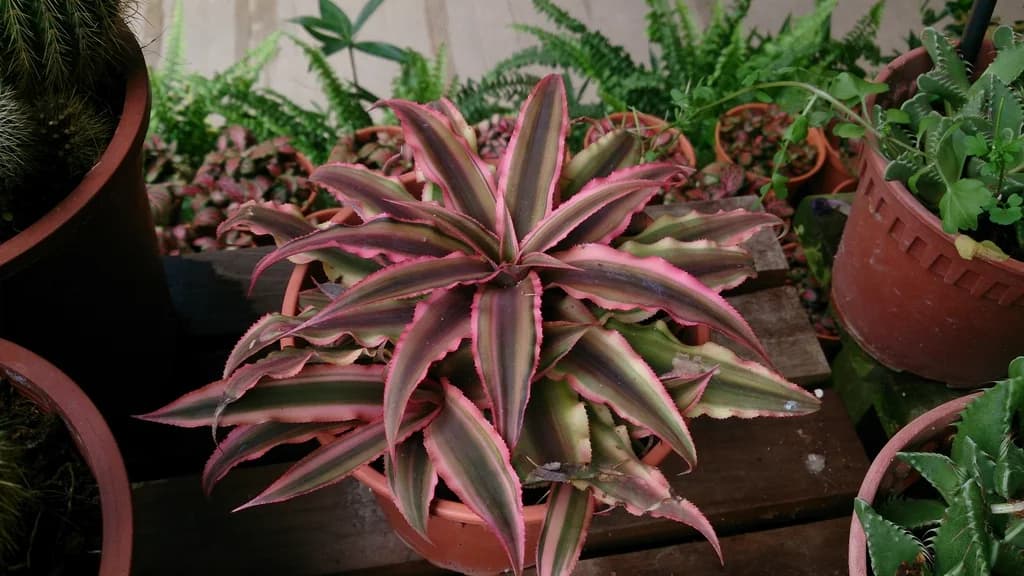
Cryptanthus bivittatus, the earth star, is the sassy ground-level bromeliad that refuses to be treated like a floating aquarium decoration. Its low striped rosette belongs in a terrestrial root zone. Grow it in drained soil, keep the centre at the surface and do not submerge its roots in aquarium water.
The word bromeliad covers plants with different habits. Do not borrow a water-filled-cup routine from another genus without species-specific evidence.
Read the rosette from centre to tip
Start at the centre where new leaves emerge, then inspect the outer leaves, soil and enclosure.
| What you notice | Check first | A useful next step |
|---|---|---|
| Colour becoming dull | Is the plant deeply shaded? Did the position change? | Move gradually into useful filtered light and judge the next leaves. |
| Pale or scorched patch | Does strong sun or hot glass reach that side? | Pull it out of harsh exposure; damaged tissue will not recolour. |
| Soft lower leaves with wet soil | Is drainage working? Is the rosette planted too deeply? | Let excess moisture leave, clear the centre and inspect roots if decline continues. |
| Dry brown tips | Is the root zone dry, or are heat and airflow changing the enclosure? | Check soil before watering and correct the condition you find. |
| Offset crowded under the parent | Does it have roots and room of its own? | Let it establish before deciding whether separation is needed. |
Keep terrestrial roots in soil
Use a loose, drained terrestrial growing medium in a setup where excess water does not remain around the roots. Set the plant so the base of the rosette is at the surface rather than buried under wet soil.
Do not place the root ball in the aquarium section of a paludarium. A humid enclosure or waterside scene does not turn a terrestrial plant into an aquatic one. Protect it from splash patterns that keep the centre constantly wet.
Check the root zone before watering. An open terrarium may dry sooner than a closed one, while a deep decorative container can hide saturation. There is no useful fixed schedule without the actual setup.
Use filtered light to hold the character
Give the rosette bright filtered light, protected from harsh direct sun through glass. Variegated colour can become less distinct in deep shade, but a sudden move into strong light can damage leaves.
Move gradually and compare new growth. Existing faded or scorched leaves will not transform after the conditions improve.
If artificial light is used, account for distance, heat and the needs of neighbouring terrarium plants. Check the light at the rosette, especially beneath taller neighbours.
Balance moisture with air around the centre
Water the root zone when the soil is dry to the touch and let excess drain. Earth stars are terrestrial bromeliads, not water-storage tanks: the centre does not need a permanent refill. In a humid enclosure, stagnant water and trapped dead material can create a problem before the soil looks dry.
Remove dead outer material gently and keep some air space around the plant. Persistent condensation, soft tissue or a sour-smelling medium calls for a drainage and ventilation check, not another automatic drink.
Keep the terrarium away from cold draughts and hot glass. Note any move so later changes have context.
Give offsets time to become plants
Earth stars produce offsets called pups. NC State recommends separating them at about one-third the adult plant's size. After flowering, the parent rosette gradually declines while its pups continue; this is a different story from sudden soft rot in wet soil.
An offset can remain as part of a fuller cluster when the container has room. Separate only for a practical reason, not because every new shoot needs its own pot immediately.
The pointed rosette needs working space. Place it where maintenance does not force your hands through sharp leaf tips or crush neighbouring plants.
For another terrarium option, compare Pilea involucrata care. Check each root zone separately rather than giving both plants one automatic watering schedule.
When the clues overlap
Confirm that the roots are in drained soil, then check planting depth, centre moisture, light and recent changes. Do not diagnose colour without looking at the root zone.
Plant Doctor can help organise a photo and saved soil, light and enclosure notes into possible checks. Its suggestions need checking against what you can observe; they are not a guaranteed diagnosis.
About the checks: the symptom table and recording suggestions are practical starting points, not a diagnosis or fixed care schedule. Botanical care references are linked below.
Quick questions
Can Cryptanthus bivittatus grow underwater?
Earth star is a terrestrial bromeliad. Grow its roots in well-drained soil, not the aquarium section of a paludarium.
Should I fill the centre like a tank bromeliad?
No. This terrestrial bromeliad is watered at its root zone. Do not maintain a water-filled central cup as you would for a tank-forming bromeliad.
How often should I water an earth star?
Water the root zone when the soil is dry to the touch, then let excess drain. Enclosure, light and soil determine the interval.
Why is the colour fading?
Check whether the plant is deeply shaded, recently moved or stressed at the roots. Improve a clear light problem gradually and judge new growth.
Can I separate the offsets?
NC State recommends separating pups when they reach about one-third of the adult plant's size. Pot them separately when you want more plants.
Is Cryptanthus bivittatus pet-safe?
The linked care reference does not establish pet ingestion safety. Absence of a warning is not proof of safety; keep it away from chewing pets.
Sources for this guide
2 sources
Spotted something that needs correcting? Send a message.