Maranta Care: Watering, Light and a Fuller Prayer Plant
Care for spreading stems and patterned leaves without relying on a fixed watering schedule.
Quick questions
Why does Maranta fold its leaves at night?
Its leaves naturally change position in a daily rhythm. This movement is different from leaves staying tightly curled or limp, and is not a complete measure of plant health.
Is a trailing Maranta normal?
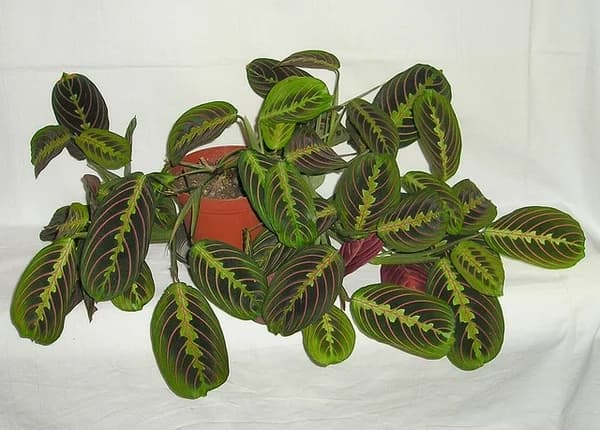
Yes. Maranta leuconeura has a spreading habit. Give the stems room; do not assume every stem reaching over the pot is a sign of insufficient light.
Should I water every week?
Use a reminder to check moisture, not to pour automatically. Keep the mix evenly moist during growth, with drainage, and adjust as light and temperature change.
Why are the leaf tips brown?
Dry roots, dry air, water quality, excess fertiliser and other stresses can contribute. Check the pot and recent conditions before assuming it only needs humidity.
How can I make another Maranta?
Divide a healthy established plant into rooted sections, or use suitable basal cuttings. A detached leaf alone is not the same as a viable cutting.
Is Maranta safe around pets?
UF/IFAS Extension lists Maranta leuconeura as non-toxic in its guidance for homes with children and pets. Confirm the species and discourage chewing; non-toxic does not mean edible.
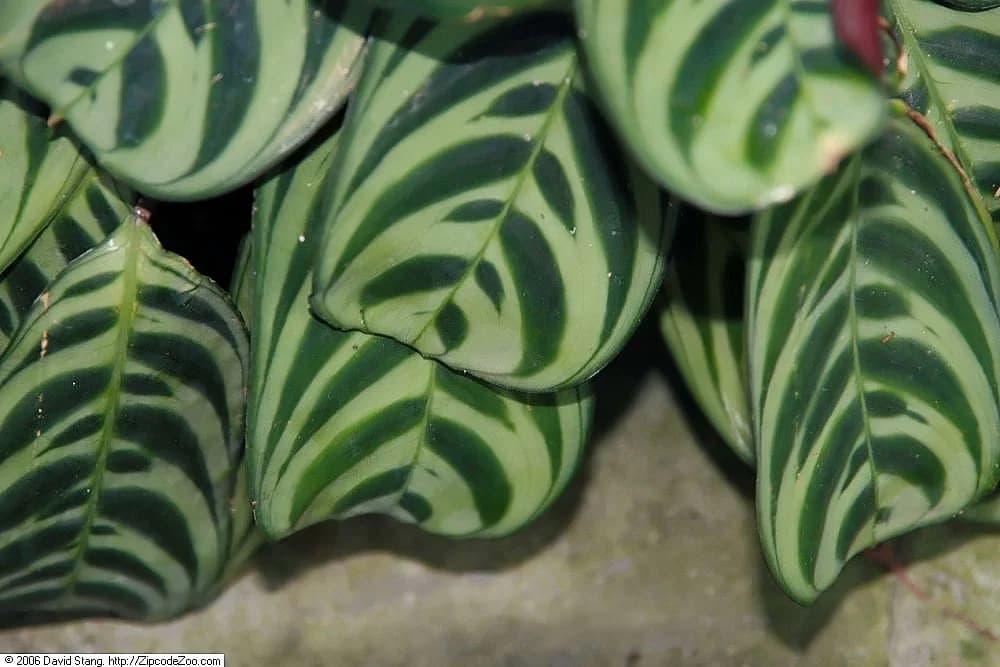
Maranta leuconeura is a prayer plant with spreading stems and patterned leaves that change position through the day. Some forms have red veins; others have rows of darker patches. It is related to Calathea and Ctenanthe, but it is not the same plant.
Its naturally spreading habit makes it useful on a shelf or in a hanging pot. Give it filtered light, humid air and consistent moisture, then let the stems have room to grow.
Choose filtered light and stable warmth
A bright position out of strong direct sun suits Maranta. Watch the actual light on the foliage: a curtain can soften a sunny window, while a deep, dark shelf may need a grow light.
Keep leaves away from cold glass and avoid heating or air-conditioning draughts. Choose a comfortably warm room where conditions do not swing sharply. Constantly moving the plant between rooms can make it harder to tell which conditions suit it.
Water the roots, not the calendar
During active growth, keep the mix evenly moist without leaving it waterlogged. Feel the surface and below it, and compare the pot's weight before deciding to water. Do not let the whole root ball become completely dry.
NYBG advises allowing the top inch to dry during winter. Use that as a seasonal adjustment when growth and water use slow, not permission to ignore a plant growing under warm, bright conditions.
Water thoroughly and empty the runoff. A hanging container or decorative sleeve can hide standing water, so check inside it. If the pot stays wet for an unusually long time, investigate drainage and root condition before adding more.
Improve dry air thoughtfully
Maranta prefers higher humidity; NYBG recommends levels well above 50%. A hygrometer helps distinguish a dry room from a guess based on one brown tip. A humidifier can be useful, while misting does not keep humidity raised for long.
Keep some air movement around the foliage without placing the plant in a draught. Avoid crowding leaves against a damp window or repeatedly soaking them in the hope of fixing crispy edges.
Support spreading growth
Use a moisture-retentive mix that drains freely and a pot with holes. Match the container to the roots rather than automatically choosing a very shallow or oversized pot. Repot when the plant is crowded, usually into a container only a little larger.
Feed modestly during active growth according to the product directions. Too much fertiliser can contribute to leaf damage, so extra food is not a shortcut to a fuller plant.
For propagation, RHS recommends division or basal cuttings. Division is straightforward when an established clump can be separated into rooted sections. Basal cuttings involve a suitable young shoot from near the base, not simply a detached leaf. Keep divisions warm, lightly moist and out of harsh sun while they settle.
Separate normal movement from a problem
Leaves lifting at night and lowering by day are normal. New leaves also emerge rolled up; do not unfold them by hand. Neither daily movement nor a temporarily still leaf is a complete health check.
For persistent curling, limp growth or browning, check moisture and drainage, then recent light or temperature changes. Look closely for mites or mealybugs. Water quality and excessive feeding can also contribute to damaged tips.
Change the most likely cause first and watch new growth. Already-brown tissue will stay brown. If your plant has upright, broad silver-striped leaves instead, compare it with the orbifolia guide before applying Maranta-specific propagation advice.
Sources for this guide
10 sources
- NC State Extension: Maranta leuconeura
- RHS: Maranta leuconeura
- NYBG: prayer plant care
- UF/IFAS Extension: houseplant safety, including Maranta
- RHS: growing calatheas
- Maryland Extension: watering indoor plants
- Maryland Extension: diagnosing indoor plant problems
- Maryland Extension: potting and repotting
- Maryland Extension: fertiliser
- Iowa State Extension: why misting does not raise humidity for long
Spotted something that needs correcting? Send a message.