Fishbone Prayer Plant Care: Light, Water and Leaf Problems
A practical guide to Ctenanthe burle-marxii and its distinctive patterned leaves.
Quick questions
Is Fishbone Prayer Plant a Calathea?
Ctenanthe burle-marxii is a separate species in the genus Ctenanthe. It is related to Calathea, Goeppertia and Maranta, but their names are not interchangeable.
How do I recognise Ctenanthe burle-marxii?
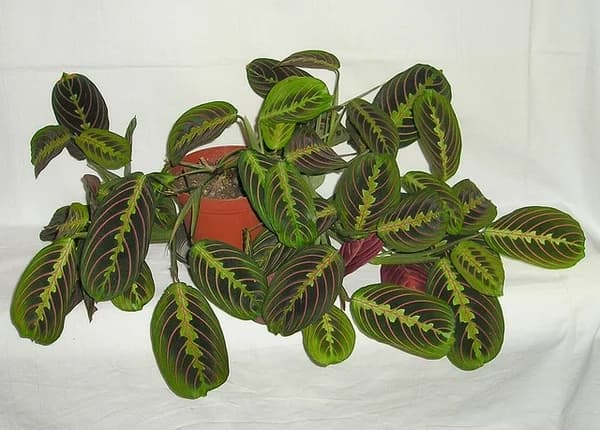
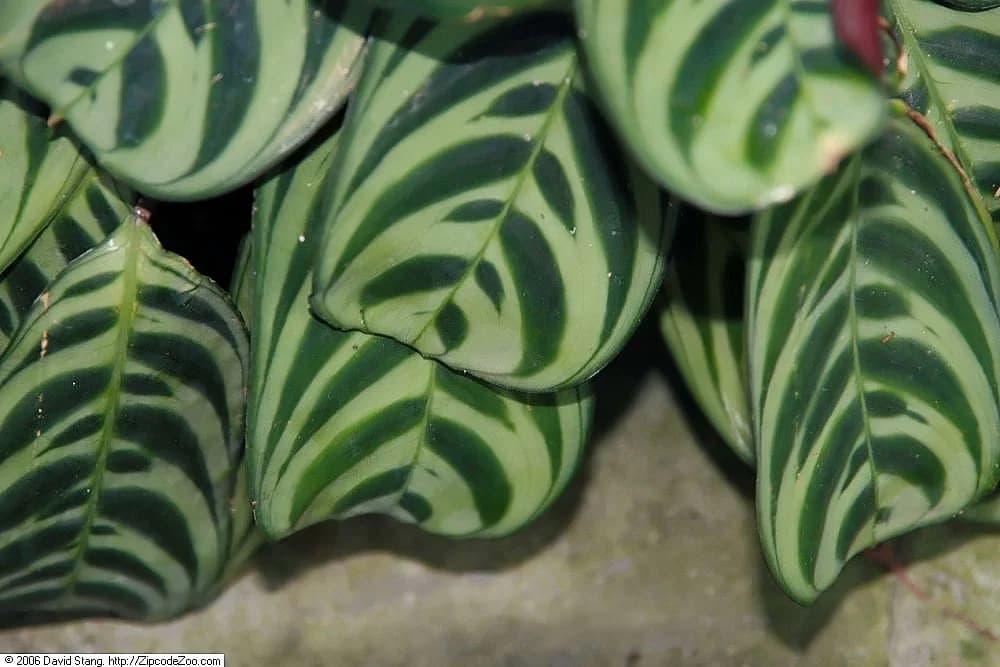
Look for pale green leaves with darker fishbone-like bands and purple undersides. Use the botanical label as well; a pattern or common name alone is not a certain identification.
How often should I water it?
Check the mix and maintain light moisture without waterlogging. Do not let the entire root ball dry out or assume that an eight-day schedule suits every room and pot.
Does it need daily misting?
No. Misting does not sustain higher humidity. Measure room conditions, address drying draughts and consider a humidifier if needed.
Can I propagate it from a leaf?
Divide a healthy established clump with roots and growing shoots in each section. A detached leaf alone is not the normal way to propagate this species.
Is Fishbone Prayer Plant safe for cats and dogs?
We have not verified a species-specific toxicology source for Ctenanthe burle-marxii. That does not establish that it is toxic; it means we cannot give an unconditional safety guarantee. Prevent chewing and seek veterinary advice about ingestion or symptoms.
The Fishbone Prayer Plant is Ctenanthe burle-marxii. Its pale green leaves have dark bands running out from the centre, with purple colouring underneath. It belongs to the same family as Maranta and the plants commonly sold as Calathea, but it is a distinct species.
Give it bright, indirect light and lightly moist, well-drained roots. There is no need to assume it is automatically easier than every Calathea or to chase a perfect leaf movement routine.
Find a bright, sheltered position
Choose a place with useful daylight, protected from strong direct sun. Leave space around the leaves rather than squeezing the plant against glass or a wall. Keep it away from cold draughts and hot, drying air from a radiator.
If the pattern looks less distinct, check exposure and overall growth before moving it. Faded or damaged foliage is not enough on its own to identify a light problem. For an unfamiliar plant, compare the botanical label as well as the leaf pattern; common names can overlap.
Keep moisture steady
Check the mix before watering. Aim for moisture through the root zone without keeping it saturated or allowing it to dry completely. Water thoroughly when needed, let the pot drain and empty any water collected in its outer container.
RHS advises keeping this species moist even in winter. That does not mean using the same amount or interval all year: a cooler, dimmer room usually means slower water use. A reminder can help you inspect the pot, but should not overrule what you find.
If leaves droop while the mix remains wet, check drainage rather than immediately watering again. Persistent wetness and dry roots can both leave a plant looking unhappy.
Make humidity and soil work together
Fishbone Prayer Plant prefers humid air. If your room is dry, measure it and consider a humidifier used according to its instructions. Repeated misting does not provide a lasting rise in humidity, and wet foliage is not the same as humid air.
Use a peat-free, moisture-retentive potting mix with good drainage and a container with holes. When roots crowd the pot, move up only a little. A very large container holds extra wet mix around a small root system.
Feed and divide during growth
Feed moderately while the plant is actively growing, following indoor-plant product directions. Reduce or pause feeding as growth slows. Do not use extra fertiliser to try to repair brown edges.
To make another plant, divide a healthy established clump in spring. Each section needs roots and growing shoots. Keep the new divisions sheltered from strong sun and check their smaller pots individually; they may use water differently from the original plant.
Check persistent leaf changes
Daily leaf movement is normal in this family, but it is not a pass-or-fail health test. For persistent curling or browning, first check moisture and drainage, then recent temperature or sun changes. Inspect stems and leaf undersides for pests, including mealybugs.
The Ctenanthe care guide explains the wider group's routine and troubleshooting. Use it alongside the species name, especially for identification: we have not verified a species-specific toxicology source for Ctenanthe burle-marxii, so we do not label it unconditionally safe for pets. Prevent chewing and ask a veterinarian or poison-information service about ingestion or symptoms.
Sources for this guide
9 sources
- RHS: Ctenanthe burle-marxii
- Kew: accepted name Ctenanthe burle-marxii
- ASPCA: identification and pet-safety guidance
- RHS: growing calatheas
- Maryland Extension: watering indoor plants
- Maryland Extension: diagnosing indoor plant problems
- Maryland Extension: potting and repotting
- Maryland Extension: fertiliser
- Iowa State Extension: why misting does not raise humidity for long
Spotted something that needs correcting? Send a message.