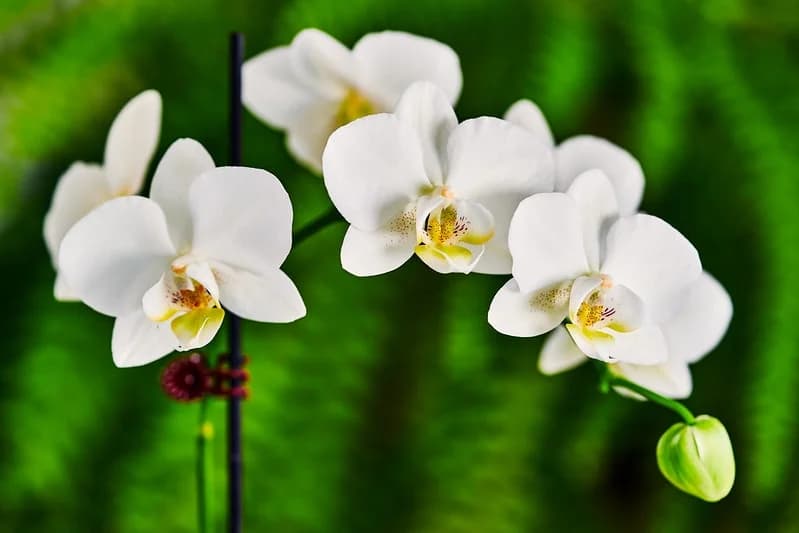
Moth Orchid Care: Watering, Roots and Reblooming
Learn what your Phalaenopsis needs in bark or moss, during and after flowering.
Quick questions
How do I know when to water my moth orchid?
Check moisture in the mix and the pot’s weight together. Water as it approaches dry; do not rely only on silvery roots outside the pot.
Is bark better than moss?
Both can work, but they dry differently. Bark is often easier to manage indoors; moss needs careful checks because its centre can stay wet.
Should I cut off roots growing outside the pot?
Keep healthy, firm aerial roots. They are normal for Phalaenopsis and are not, by themselves, a reason to cut or repot.
Is my orchid dead after the flowers fall?
No. Keep caring for its roots and leaves. A healthy plant can flower again, although the timing varies.
Should I cut the flower spike after blooming?
Remove a brown, dry spike. A green spike on a healthy plant can remain or be trimmed above a healthy node; a further flush of flowers is not certain.
Are moth orchids safe for cats and dogs?
The ASPCA lists Phalaenopsis as non-toxic to both. Discourage chewing and contact a vet if a pet becomes unwell after eating any plant or potting material.
A moth orchid is still a living plant after its last flower falls. Healthy roots and leaves support the next flowering cycle, so caring for those is more useful than trying to force another spike immediately.
This guide is for the common Phalaenopsis hybrids sold as indoor moth orchids. Other orchid groups can need different care.
Choose bright, filtered light
Place your orchid near a bright window, with protection from strong summer sun. Check the actual conditions at the leaves: window direction alone does not account for shading, season or hot glass.
Do not diagnose low light from dark green leaves alone. Some Phalaenopsis hybrids naturally have darker foliage even in suitable light. Consider growth, flowering and the position together.
Keep temperatures steady, away from heaters and cold draughts. Avoid pressing leaves against cold window glass at night.
Water for the mix inside your pot
Bark and sphagnum moss hold water differently. Moss can stay wet in the centre long after the outside looks dry; bark generally allows more air around the roots. A calendar cannot tell you what is happening inside either one.
Check the weight of the pot and the moisture in the mix. A clear nursery pot helps you see below the surface. Water when the mix is approaching dry, before the plant spends a long period completely dried out.
Visible roots often look greener when wet and more silvery as they dry. Treat that as one clue, not a command to water: an exposed aerial root can be silver while the centre of the pot is still wet.
At the sink, run room-temperature water through the mix and let it drain thoroughly. Empty the decorative pot before replacing the orchid. Keep water out of the crown, the central point where leaves emerge; blot away any that collects there.
Keep air around healthy roots
Use an orchid mix suited to Phalaenopsis, usually bark-based for home growing. Ordinary houseplant compost is too dense for this routine. If your orchid is already healthy in moss, learn its drying pattern rather than replacing it just because moss is present.
Repot when the mix breaks down or the roots have outgrown the container. A pot just large enough for the healthy roots is preferable to a much bigger one full of wet mix. After flowering is a useful time for a planned repot, but deteriorating roots should not be ignored until the flowers finish.
Gently remove old material and examine the roots. Keep firm roots, including silvery aerial roots. Remove soft, rotten or hollow dead sections with clean tools. Colour alone is not a reason to cut. Keep the crown above the mix rather than burying it.
Feed lightly during growth
Use an orchid fertiliser at its labelled dilution and frequency. Account for slower growth rather than feeding more to make up for missing flowers. Periodically use plain water through the pot to help flush accumulated fertiliser salts.
If the room is very dry, a humidifier can help, but more humidity is not a substitute for watering the roots correctly. Avoid keeping the crown wet or the pot enclosed in stagnant, damp conditions.
Care after the flowers fade
If a flower spike has become brown and dry, remove it near its base without cutting the leaves. On a healthy plant, a still-green spike can be left or trimmed above a healthy node to encourage a side branch. Repeat flowering is not guaranteed.
Give a struggling plant time to rebuild roots and leaves before trying to encourage blooms. For a healthy, established plant that has not flowered again, review light first. A modest cooler period can help initiate a spike, but keep it within warm indoor conditions, above about 16°C, rather than exposing it to cold shocks.
Check problems before changing care
Wrinkled leaves: check the mix and roots. A dry pot may need water; a wet pot with damaged roots cannot necessarily use more.
Yellow leaves: consider which leaves are affected and how quickly. An ageing lower leaf is different from several leaves deteriorating together.
Buds dropping: look for recent changes in temperature, watering or position. Do not assume that the plant needs fertiliser.
Sticky patches or white cottony material: look closely for pests, including mealybugs, and separate an affected plant while you identify the problem.
Phalaenopsis is listed as non-toxic to cats and dogs by the ASPCA. Still keep plants and potting materials away from pets that chew them; non-toxic does not mean intended as food.
Spotted something that needs correcting? Send a message.